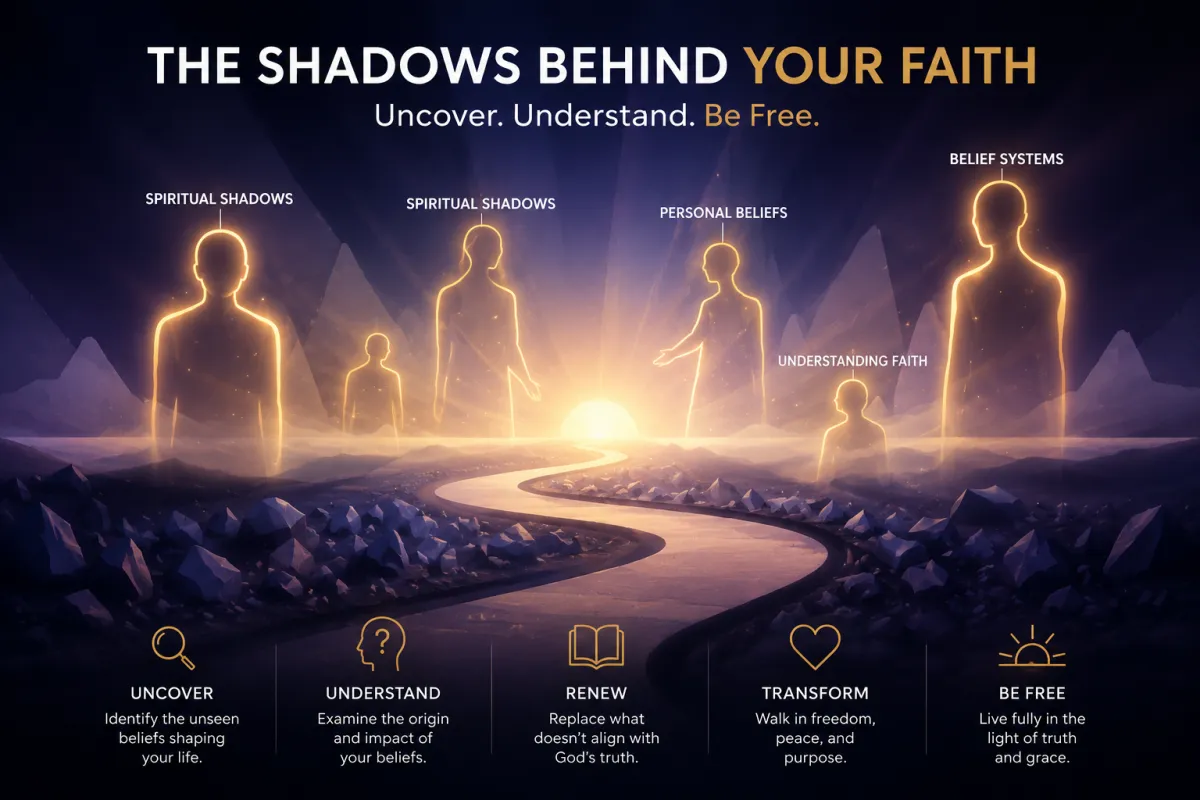
Exploring Faith: Uncover Beliefs and Their Origins
Faith Exploration, Belief Systems, Spiritual Growth
The Shadows Behind Your Faith: What Do You Believe and Why Do You Believe It?
Your faith did not appear out of nowhere. It carries stories, questions, doubts, and quiet assumptions you may have never examined. Exploring those hidden layers is not an act of betrayal; it is an act of honesty. This is where faith exploration begins—by daring to look at the shadows behind what you say you believe.
Faith/Exploration: What Do You Believe and Why Do You Believe it. Stepping Beyond Comfortable Answers
Some people inherited their faith but never examined it. Some people inherited fear and called it wisdom. Inherited religion and called it relationship. Inherited silence and called it holiness. Inherited performance and called it righteousness.
And somewhere along the way, many people stopped asking questions because questioning was interpreted as rebellion instead of revelation.However, if you never examine the roots of your beliefs, you may spend your entire life defending ideas you never truly understood.
Faith exploration is the ongoing process of asking, re-asking, and refining what you hold to be true. Rather than treating faith as a fixed destination, it views it as a journey. You may have inherited beliefs from family, culture, or community, but exploration invites you to ask, Do these still fit the person I am becoming? This is not about dismantling faith for the sake of it; it is about moving from borrowed convictions to personal ownership.
When you engage in genuine faith exploration, you allow room for doubt, curiosity, and growth. You begin to see that strong faith is not the absence of questions, but the courage to carry those questions into the presence of what you hold sacred.
Belief Systems: The Invisible Framework Guiding Your Life
Every person lives within a belief system, whether religious, spiritual, secular, or a mix of all three. A belief system is the framework that answers your deepest questions: Who am I?What matters?What is right and wrong?What happens when life ends? Even choosing not to believe in anything beyond the material world is, itself, a belief system.
Understanding your belief system means noticing the stories you tell yourself about success, suffering, love, and purpose. It means recognizing how tradition, upbringing, trauma, education, and culture have shaped your assumptions. This awareness does not force you to abandon your beliefs; it simply lets you see the structure you are standing on, rather than walking blindly across it.
Faith Can Be Genuine… and Still Contain Shadows
Sometimes what we call “faith” is actually:
fear of rejection
fear of punishment
fear of questioning
fear of losing community
fear of disappointing people
Which could mean, some people are not serving God from love. They are serving from shadows.
“There is no fear in love; but perfect love casteth out fear…”1 John 4:18 (KJV)
If fear is constantly driving your relationship with God, then somewhere love and understanding may have been overshadowed by control and anxiety.
The Shadow of Fear in Faith
For many people, faith became connected to fear before trust.
“If you do this, God will punish you.”
“If you question this, you are rebellious.”
“If you struggle, your faith must be weak.”
And instead of developing intimacy with God, many developed anxiety around God. That is not freedom. That is fear wearing church clothes.
And fear-based faith often creates:
judgment
performance
hiding
perfectionism
emotional suppression
spiritual exhaustion
And then, people begin performing spirituality instead of experiencing transformation.
Spiritual Shadows: What Hides Behind Your Convictions
Wherever there is light, there are shadows. The same is true of your spiritual life. Spiritual shadows are the unexamined motives, fears, and wounds that hide behind your most confident statements of belief. They can look like:
Clinging to certain doctrines mainly because you fear rejection if you let them go
Using faith language to avoid hard emotions or complex realities
Confusing genuine trust with denial, or devotion with people-pleasing
Naming these spiritual shadows is not about shaming yourself. It is about letting light reach the parts of your faith that have been driven more by fear than by love. When you face those shadows honestly, your beliefs can become cleaner, kinder, and more aligned with your deepest values.
Personal Beliefs: Moving from Inherited to Chosen
At some point, every person must decide whether their faith will remain inherited or become personal. Personal beliefs are those you have wrestled with, questioned, and ultimately chosen. They may resemble the faith of your family or look very different, but they are yours because you have met them with your whole self—mind, heart, and experience.
Some Beliefs Were Never Challenged
Some people believe what they believe simply because mama believed it, pastor said it, culture repeated it or tradition normalized it. But maturity requires examination. At some point you must ask:
What aligns with love?
What aligns with truth?
What aligns with wisdom?
What produces life?
What reflects the character of God?
Because repetition does not automatically make something revelation.
Scripture
“Prove all things; hold fast that which is good.” 1 Thessalonians 5:21 (KJV)
God never told us to blindly absorb everything without discernment.
One practical way to clarify your personal beliefs is to write them down in your own words. Instead of repeating familiar phrases, try explaining what you believe about love, justice, forgiveness, or God as if you were speaking to a close friend. Where do you feel solid? Where do you hesitate? Those hesitations are invitations to deeper understanding, not signs of failure.
Coach PBJ Tip: Pay attention to the beliefs that bring peace, courage, and compassion. These often point toward convictions that are truly yours, rather than ones you feel pressured to hold.
Why We Believe: God Is Not Threaten By Questions
Asking why we believe can be more unsettling than asking what we believe. Yet this question is crucial. One of the greatest deceptions ever taught is that questioning means lack of faith. Sometimes questioning is the beginning of awakening. Questions are often invitations into deeper understanding. And people who are afraid of questions are usually protecting systems, not truth.
“Come now, and let us reason together, saith the Lord…" Isaiah 1:18 (KJV)
God invited conversation.
God invited reasoning.
God invited understanding.
People believe for many reasons: comfort in suffering, a sense of belonging, powerful experiences we cannot easily explain, the influence of people we trust, or a deep intuition that there is more to reality than we can see.
None of these reasons are automatically good or bad. The key is to recognize them. Are you holding on to a belief mainly because you are afraid of losing your community? Are you rejecting faith because of past hurt rather than present conviction? When you understand the stories beneath your beliefs, you can choose them with greater integrity—or release them with greater honesty.
The Shadow Behind Religious Performance
Some people know how to:
• shout
• preach
• quote scripture
• sing
• serve
• lead
…but have never healed. Because religion can hide dysfunction very well. Church attendance can hide insecurity. Titles can hide trauma. Serving can hide abandonment wounds. Performance can hide emptiness.
And many people are exhausted because they have spent years trying to look spiritually alive while emotionally disconnected from themselves.
“This people draweth nigh unto me with their mouth, and honoureth me with their lips; but their heart is far from me.” Matthew 15:8 (KJV)
External performance does not always equal internal transformation.
Faith Was Never Meant to Disconnect You From Yourself
Real faith should produce wisdom, compassion, discernment, growth, healing, love, truth, peace.
Not constant fear. Not emotional suppression.Not pretending. Not hiding. Not living disconnected from your humanity. God does not heal the version of you that performs.
Healing begins when truth enters the room.
“And ye shall know the truth, and the truth shall make you free.” John 8:32 (KJV)

Coach PBJ’s Final Thought
Some of the greatest shadows are hidden behind unquestioned beliefs. Many people are carrying inherited guilt, inherited shame, inherited fear, inherited theology, and inherited limitations without ever pausing to ask, “Is this truly God, or is this conditioning?” Faith should not imprison your mind; it should awaken your spirit. So today, take a moment to reflect honestly with yourself.
What do you believe, and why do you believe it?
Which beliefs have brought you freedom, peace, and growth, and which ones have produced fear, silence, or limitation?
What parts of your faith journey may require deeper healing, deeper truth, and deeper understanding?
Remember, God is not afraid of your questions, and truth does not fear examination.
We do not heal by pretending the shadows are not there. We heal by bringing them into the light.
I help high-functioning women uncover hidden shadows, reclaim their identity, renew their mindset, and walk boldly in purpose so they can shine.
Ready to stop carrying what you were never meant to keep?
Join theSHIFT Communityand begin your journey from shadows to shine.