The Shame That Stood Beside My Grief
The Shame That Stood Beside My Grief
By Dr. Paula Burch Jackson | Coach PBJ Speaks
This is not an easy story for me to tell, but it is a necessary one. I share it because grief has a way of making us feel alone, and shame has a way of convincing us that we should suffer in silence. For years, I carried parts of my grief quietly because I did not know how to explain the depth of what I was feeling. I was a woman of faith, a minister, a wife, a mother, and a leader, but I was also a woman whose heart had been shattered. Robert passed away in 2006, but it took me eighteen years to give myself permission to grieve without shame telling me how I was supposed to feel, think and move. This is my truth, my transparency, and my testimony of what happens when grief and shame try to stand in the same place.
There are some losses that do not just break our hearts. They challenge everything we thought we understood about faith, prayer, strength, and ourselves. When my first husband, Robert, went into the hospital, I believed he was coming home. That was not a casual hope. That was not wishful thinking.That was my confession of faith.
I was Elder Burch. I prayed for other people, and I had seen God answer. I believed in healing. I believed in miracles. I believed God could do anything.
And nothing in heaven or hell could make me believe that Robert would not walk out of that hospital and come back home. No matter what it looked like, I held on. No matter what the doctors said, I held on. No matter what the circumstances suggested, I held on.
Faith was not foreign to me. Prayer was not foreign to me. Believing God was not foreign to me. I had stood in faith before. I had prayed for others before. I had seen God move before. So when it came to Robert, my husband, my love, my life partner, I stood with everything I had.
Until I could not.
Robert died.
And when he died, grief did not come alone. Shame stood beside it. Not quietly. Not gently. Not from a distance.
Shame came close and began asking questions my broken heart was too weak to answer.
Did I not pray hard enough?
Did I not believe long enough?
Did I miss God?
Was my faith not strong enough?
Did I say the wrong thing?
Did I confess the wrong thing?
How could I pray for other people and see God answer, but not see the answer I believed for when it came to my own husband?
How could I be Elder Burch and feel this broken?
How could I stand before people as a woman of faith when my own faith felt shattered by the outcome?
That is what shame does. It does not just make us feel pain. It makes us feel wrong for having pain.
When Faith and Grief Collide
I did not know then how to separate my grief from my shame. I thought if I admitted how devastated I was, it might mean I did not have faith. I thought if I cried too hard, people might think I did not trust God. I thought if I questioned what happened, God might be disappointed in me. I thought if I told the truth about how broken I felt, it would somehow dishonor the confession I had made.
So I carried more than grief. I carried confusion. I carried disappointment. I carried the pressure of being strong. I carried the weight of being watched. I carried the identity of Elder Burch while trying to survive the pain of being Paula, the widow.
And that is a heavy place to live. Because sometimes the title people know us by does not leave room for the pain we are carrying privately.
People saw the elder. But I was also a woman whose husband had died.
People saw the one who prayed. But I was also the one trying to understand why my prayer did not end the way I believed it would.
People saw faith. But I was also carrying sorrow so deep that I did not know what to do with it.
And because I did not know how to grieve without feeling ashamed, I tried to function through what I needed to feel. I smiled. I served. I showed up. I prayed. I encouraged others. I kept moving.
But inside, shame was sitting on top of my sorrow, telling me to keep it together because people were watching.
The Shadow of Shame in Grief
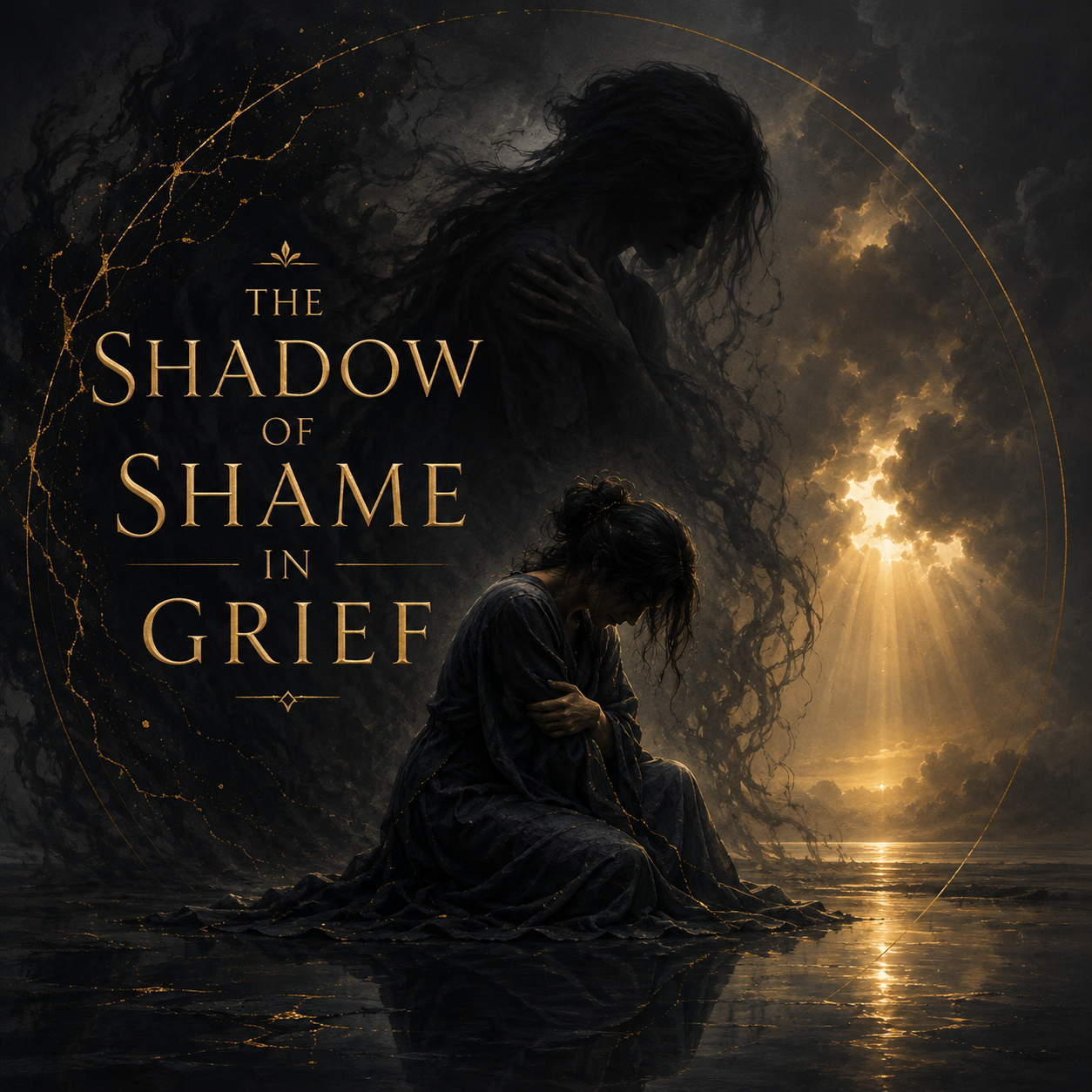
Shame is one of the most silent shadows because it knows how to hide behind responsibility. It hides behind strength. It hides behind ministry. It hides behind titles. It hides behind the phrase, “I’m okay.”
But shame does not heal grief. It holds grief hostage. It tells us we should be stronger than we are. It tells us we should be over it by now. It tells us our tears are a lack of faith. It tells us our questions are proof of doubt. It tells us our pain is proof that we failed somewhere.
But grief is not failure.
Grief is love looking for somewhere to go. It is the soul trying to process what the heart was not ready to release. Grief is not a lack of faith. It is the human response to loss.
And sometimes the deepest grief comes when we believed God for one outcome and had to live through another. That kind of grief is complicated. Because we are not only grieving the person. We are grieving the future we imagined. We are grieving the prayers we prayed. We are grieving the faith picture we held in our hearts. We are grieving the return home that never happened. We are grieving the testimony we thought we would tell.
And when shame enters that space, it whispers:
You must have done something wrong.
Faith does not make us immune to grief. It gives us somewhere to take our grief.
When Shame Delayed My Grieving
Looking back, I can see that shame delayed my grieving. It did not stop the grief. It only pushed it deeper. It made me perform strength when my soul needed permission to be honest. It made me manage my appearance when my heart needed space to break. It made me question myself when what I really needed was compassion.
I needed to grieve as Paula. Not as the elder.
Not as the woman people expected to be strong. Not as the one who always knew what scripture to quote. Not as the one who could pray everybody else through.
I needed to grieve as the woman who loved Robert. The woman who believed he was coming home. The woman who had to face the reality that he was not. The woman who had to wake up in a world that looked the same but would never feel the same again. The woman who had to learn how to breathe with a broken heart.
Shame tried to make my grief about my faith performance.
It tried to convince me that if I was hurting deeply, I must not have trusted God deeply. Because trusting God does not mean we do not hurt. Trusting God does not mean we do not cry. Trusting God does not mean we do not wrestle.
Jesus wept. Jesus cried out. Jesus experienced agony. So why do we think grief makes us less spiritual?
The Questions Shame Asked Me
Shame asked questions that sounded spiritual, but they were rooted in accusation.
Why did you not have enough faith?
Why did God answer others but not you?
What will people think?
How can you still minister?
How can you still pray?
How can you still believe?
Healing ask:
What happened to your heart?
What did this loss do to your spirit?
What part of you needs permission to grieve?
What pain have you hidden behind your title?
What sorrow have you spiritualized instead of feeling?
What truth have you been afraid to say out loud?
Those are the questions that began to lead me back to myself, because I had to learn the difference between truth and shame.
Truth invites us out of hiding. Shame pushes us deeper into it.
Truth brings clarity. Shame brings condemnation.
Truth says, “Come here, daughter.” Shame says, “How could you?”
And after Robert died, shame kept trying to pull me into hiding. But God was not ashamed of my grief. God was not offended by my tears. God was not shocked by my questions, and He was not intimidated by my brokenness. God could handle the pain I was afraid to admit.
Shame tried to steal my right to grieve. It tried to steal my voice, my peace, my confidence in prayer, my identity. It tried to make me believe Robert’s death was somehow a reflection of my spiritual failure. But God!
Becoming Her Again
Shame did not just stand beside my grief. It changed the way I saw everything. For a season, I interpreted life through the lens of loss. Grief became the filter through which I processed people, relationships, faith, friendship, silence, expectations, and even God. Everything that once felt familiar suddenly felt foreign. Everything that once felt safe suddenly felt uncertain. Everything that once felt steady suddenly felt unstable.
Because shame was wrapped around my grief, I did not just question what happened. I began questioning what I believed and why I believed it. I questioned my faith, my prayers, and what I had been taught. I wondered how I could believe God so deeply, pray so sincerely, stand so firmly, and still have to bury the man I believed I would grow old with. That kind of grief does not just break the heart. It shakes the foundation.
While I was trying to survive that shaking, the people closest to me did not always understand the depth of what I was carrying. They saw that Robert was gone, but they did not always understand that part of me felt gone too. I had lost more than my husband. I lost the life we built, the rhythm we shared, the future I imagined, the safety of “us,” and the couple identity people knew and loved. Robert and I had been the friends people loved being around. But after his death, I was no longer showing up as “Paula and Robert.” I was showing up as Paula, the grieving widow, and I suppose that version of me was not as easy for everyone to sit with.
Grief changed my capacity. I did not have the same emotional strength, social energy, or ability to show up, smile, explain, engage, or pretend. I needed grace, but some people required more than I had the capacity to give. And when I could not be who they were used to me being, some walked away. That became another loss. I lost Robert, then I lost pieces of community, friendships I thought were solid, familiar circles, and the version of myself people preferred.
Abandonment after loss feels like grief being confirmed. It whispers, “See, you really are alone.” It makes the silence louder and the shame heavier. It makes the heart wonder, “Was I only relevant when Robert was around?” That is a painful question, but it is honest.
For a long time, I did not know how to become myself again because I did not know who I was without the life I had known. I had to learn how to be Paula without Robert. I had to learn how to pray without using prayer to avoid pain. I had to learn how to believe again without pretending I did not have questions. I had to learn how to stop apologizing for not having the capacity to be everything for everybody while I was grieving.
Slowly, healing taught me something shame never could. I did not have to become the old me again. I had to become her again. Not the version of me untouched by loss. Not the version of me who had all the answers. Not the version of me who could hold everybody else while secretly breaking. But the woman underneath the grief, the title, the expectations, and the shame. The woman who was still there, even when I could not feel her.
Becoming her again was not about going back. It was about coming home to myself in a new way. It was learning that grief may change us, but it does not have to erase us. People may leave, but we do not have to abandon ourselves. Faith may be questioned, but questions do not mean faith is dead. Losing what was familiar does not mean we are lost forever.
I know now that I did not just need to recover from Robert’s death. I needed to recover from the shame, the silence, the abandonment, the identity loss, and the belief that my grief made me too much for people to love. Becoming her again meant giving myself permission to grieve what I lost without becoming lost in it forever. It meant allowing God to touch the parts of me that people did not know how to hold.
What I know now is this: grief and faith can live in the same heart. Tears do not make us faithless. Questions do not disqualify us from being loved by God. Titles do not exempt us from pain. We can love God and still be heartbroken. We can trust God and still cry. We can be strong and still need support. We can be spiritual and still need space to fall apart. We can be called and still be crushed. We can be anointed and still be aching. We can be Elder Burch and still be Paula.
That is where my healing began. Not when I denied the pain, but when I stopped letting shame interpret it.
Maybe someone reading this has been carrying grief wrapped in shame. Maybe you prayed for healing and still had to attend the funeral. Maybe you confessed life and still faced death. Maybe you have wondered whether your faith was not enough. Maybe you have been trying to grieve quietly because people expect you to be strong. But I want you to hear me: you are allowed to grieve. You are allowed to cry. You are allowed to admit that it hurt. You are allowed to have questions. You are allowed to be human.
Grief is not a betrayal of faith. Grief is evidence that love was present. And shame has no right to stand guard over your sorrow.
Coach PBJ’s Closing Thoughts

For years, I thought I had to be strong enough to survive what broke me. But now I understand something different. Healing did not begin when I became stronger. Healing began when I became honest. Honest about the pain, honest about the questions, honest about the disappointment, honest about the shame, and honest about the woman behind the title.
Because the title could not grieve for me. The title could not cry for me. The title could not heal for me. Elder Burch had faith, but Paula had to grieve, and God loved both. He loved the woman who believed and the woman who broke. He loved the woman who prayed and the woman who questioned. He loved the woman who stood and the woman who collapsed under the weight of loss. That is grace. That is mercy. That is healing.
So today, I no longer believe shame had a right to stand beside my grief. It showed up, but it did not belong there. Grief needed compassion. Grief needed truth. Grief needed time. Grief needed God. And grief needed permission to breathe without being judged.
So if shame has been standing beside your grief, maybe it is time to tell shame, “You do not get to interpret my pain anymore. You do not get to measure my faith by my tears. You do not get to call my grief weakness. You do not get to turn my loss into my failure.”
I can grieve and still believe. I can cry and still trust God. I can hurt and still be held. Because healing is not pretending the loss did not break us. Healing is allowing God to meet us in the broken place without letting shame tell the story.

We do not heal by pretending the shadows are not there. We heal by bringing them into the light.
I help high-functioning women uncover hidden shadows, reclaim their identity, renew their mindset, and walk boldly in purpose so they can shine.
Ready to stop carrying what you were never meant to keep?
Join the SHIFT Community and begin your journey from shadows to shine.